Contents
- Key takeaways
- Twelve criteria, side by side
- 1. What our own move off Webflow actually changed
- 2. Speed depends on who measures
- 3. What agents changed in 2026
- 4. Who changes the site, and what that costs
- 5. The cost code does not remove
- 6. Leaving, and the line that blurred
- How to decide: five questions, with a company for each
- Method and limitations
- Find out which one fits your company
- Frequently asked questions
Webflow suits a site that marketing edits page by page; code suits a site that needs logic, data or agents editing hundreds of pages at once. Until recently code also meant an engineering team, and in 2026 it no longer does. Nine companies have published a move to code, seven of them in the last ten months, and none has published a move back. We compare the two on twelve criteria, publish the before and after of our own migration off Webflow, and name the one cost code does not remove.
Verdict
Choose Webflow when the site is pages that marketing edits itself and nobody on the team will own a repository. Choose code when the site needs a login, a configurator, data from internal systems, or pages that agents update in hundreds. The old objection to code, that it takes an engineering team to write, has weakened: agents write it cheaply. The cost that remains is keeping the runtime current, and that one is real.
Next.js
Best for
A site that is becoming a product: a client area, a configurator, prices from an ERP, pages generated from internal data. A site whose pages agents update in hundreds. A team that already has a repository and a review process.
Not for
Nobody will raise the framework version in two years. The team is one marketer who needs to move a block today. The budget covers the build but not the upkeep. In Ukraine one agency quotes 7,800 euro for a starter site in code against 1,200 for the same site in a builder.
Webflow
Best for
A marketing site of pages: services, cases, a blog, landing pages for campaigns. A team without a developer that changes the site every week. A company that wants no version to upgrade and no repository to own.
Not for
The site needs a login, server logic or a large catalogue synchronised with an internal system. Agents have to update hundreds of pages: the Data API allows 60 to 120 requests and one publish a minute. Every editor costs a seat.
The argument runs the same way at every first meeting. The developer wants code, because the site will outgrow the builder. The marketing lead wants the builder, because otherwise every edit becomes a task for the developer. Both have been right for years, and the usual verdict was that code belongs to companies with an engineering team.
That verdict is the part that changed. In 2026 agents write the code, and the companies that publish their migrations are moving in one direction. We are one of them: this site lived on Webflow, and below we publish what the move actually changed. This page is for you if you already have a website and are choosing what to build the next one on. Below: twelve criteria in one table, then the rows that decide, each with its numbers and their sources.
Key takeaways
- The entry threshold for code has fallen. Nine companies have published a move from a builder or a CMS to code, seven of them since December 2025, and none has published a move back. One of them cost $260 in tokens; another team moved 2,500 pages in two months. In May Webflow itself said that lightweight builders and AI tools now offer a faster path to launch for simple sites.
- Speed comes from whoever measures. In Chrome's field data for August 2026, 71.2% of Webflow sites and 35.1% of Next.js sites pass all Core Web Vitals on mobile. On our own migration the page lost 19 MB, and the platform accounts for 0.16 MB of that. The rest was video, a booking widget and images, all of them our own decisions.
- Code does not remove one cost: the runtime. A major version of Next.js is supported for two years, security releases land about monthly, and version 14 is already unsupported. Webflow has no version for you to upgrade. This is the one row where the builder wins without a caveat.
Twelve criteria, side by side
Prices and limits are from webflow.com/pricing and vercel.com/pricing on 22 September 2026, yearly billing where offered. Field speed comes from the HTTP Archive Technology Report for August 2026, which joins Chrome's real-user data with detected technologies: Next.js and Webflow. We measured our own before and after the same day; the method is at the end and the raw data is a CSV file. On our position: we build on Webflow and in code, this site is in code, and the sections below include the numbers that do not flatter that choice.
| Criterion | Next.js | Webflow |
|---|---|---|
| Who can change a page | Anyone with repository access; a marketer needs a CMS on top | Anyone with a seat, in the browser |
| Cost of the editing layer | Headless CMS: Sanity from $15 a seat, Contentful Lite $300 a month | Included; editor seat $15, designer seat $39 |
| Hosting | Vercel Pro $20 plus $20 a developer seat; Netlify Pro $20 without seat fees; Cloudflare from $0 | Included in the site plan, $15 to $25 |
| History of changes | Git: every change is visible, reviewable and revertable | Site activity log, on the Team plan at $2,500 a month |
| Agents editing pages | Hundreds of pages in one commit | Data API: 60 to 120 requests and one publish a minute |
| Logic, logins, internal data | Anything you can write | Webflow Cloud runs your own app, with limits |
| Speed, field data | 35.1% of sites pass Core Web Vitals on mobile | 71.2% of sites pass Core Web Vitals on mobile |
| Version to keep current | Two years of support per major; security releases about monthly | None on your side |
| Build cost in Ukraine | One agency's published rate: 7,800 euro, 8 to 9 weeks | The same agency: 1,200 euro, 2 to 3 weeks |
| Free tier for a company site | Vercel Hobby is non-commercial use only | Starter: 2 pages, a webflow.io domain |
| Leaving | The repository is yours; the host is replaceable | HTML and CSS export on a Workspace plan; CMS content does not export with it |
| Market direction | Share among JS libraries doubled in a year, 2.2% to 4.5% | 1.2% of sites with a known CMS, flat for a year |
1. What our own move off Webflow actually changed
Until this month figmatica.com was a Webflow site. We kept the whole of it: the pages, the stylesheet, the scripts and every file from the CDN. To compare the two honestly we served the old site locally, rewriting its CDN addresses to the saved copies, and built the new one. Then we ran Lighthouse 13.5 three times against each: mobile emulation, same machine. Of the 152 asset references on the old home page, 151 resolved locally.
| Home page, English | Webflow, before | Next.js, after |
|---|---|---|
| Page weight | 20.88 MB | 1.74 MB |
| Requests | 177 | 55 |
| Blocking time | 2,682 ms | 490 ms |
| Words readable without JavaScript | 1,066 | 1,700 |
| Pages on the site | 5 | 86 |
| Of the six AI readiness checks | 1 of 6 | 6 of 6 |
Nineteen megabytes is a number worth breaking down, because it is the one people credit to the platform. On the old home page the video took 12.8 MB, the images 3.7 MB across 106 requests, the booking widget 2.6 MB of script and stylesheet, the fonts 1.2 MB. Webflow's own runtime took 372 KB, which is 1.7% of the page. On the new page the Next.js runtime takes 208 KB. The platform accounts for 0.16 MB of the 19 that went. The rest came from decisions we could have made and kept: drop the autoplay showreel, replace the booking widget, redo the images. A team that stayed on Webflow and made the same three decisions would have got most of the same result.
Responsibility moved with the weight. On a builder the platform decides how fonts load, how images are sized and what the page does while it is still loading. In code someone on the team decides each of those, and forgets to revisit it. The next section measures that trade across tens of thousands of sites.
2. Speed depends on who measures
Leaving a builder, developers most often name one reason: a coded site will be faster. The field data does not bear that out. The HTTP Archive Technology Report joins Chrome's real-user measurements with detected technologies. For August 2026 it shows that all three Core Web Vitals pass on mobile for 71.2% of Webflow sites and 35.1% of Next.js sites, from 60,684 and 374,612 origins. The gap has held for fourteen months without closing.
One caveat matters: those Next.js origins include web applications, dashboards and shops, not only marketing sites, so this is not a controlled experiment. These numbers describe a ceiling and a floor: code raises the ceiling and lowers the floor. A team that measures gets a faster site in code than a builder can produce. A team that does not measure gets a slower one, and the framework will not catch that for it.
3. What agents changed in 2026
Speed does not decide this choice. The cost of writing the code decided it for years, and that cost moved this year. Nine companies have published a migration from a builder or a CMS to code, seven of them since December 2025, and none has published a move in the other direction. Lee Robinson of Cursor described in December 2025 how he moved their site off a CMS: $260.32 in tokens across 344 agent requests and 67 commits. One team moved a site of about 2,500 pages in two months with two and a half developers. Eric Brownrout of Frigade, moving off a builder in May 2026, put the reason plainly: engineering attention is no longer the bottleneck.
Webflow said much the same about its own market on the day it cut staff. On 27 May 2026 the company wrote that AI tools and lightweight builders are providing a faster path to launch for those with simple website requirements. It repositioned itself towards teams that need more than a website. When a vendor concedes the simple segment, you can stop asking whether code is affordable to write.
Two facts temper this. No non-technical marketing team ran any of the nine migrations: agencies, growth engineers and founders did. Separately, one team that tried giving marketers an AI editor instead of a CMS gave up and spent ten days building an editing interface of its own. And in Ukraine the price of building still follows the old logic. One agency that sells both publishes 1,200 euro and two to three weeks for a Webflow site. For the same site in Next.js it asks 7,800 euro and eight to nine weeks.
4. Who changes the site, and what that costs
Most cases are decided by a different row: who opens a page to change it. In Webflow a marketer opens the editor and changes a page. In code a marketer opens nothing, unless you buy an editing layer: a headless CMS. Sanity starts at $15 a seat on its paid tier, which is exactly what a Webflow editor seat costs. Contentful Lite is $300 a month, twelve times a Webflow Premium plan. Strapi is free as software and then wants hosting. In subscriptions "code plus a CMS" costs about what Webflow costs, before anyone is paid to connect them.
Put three years on it. A company site on Webflow Premium with one editor seat is $40 a month, or $1,440 over three years. The same site in code, on Vercel Pro with one developer seat and Sanity for the editing, is $55 a month, or $1,980. The subscriptions land within a few hundred dollars of each other, the same as they did on our Webflow or Framer page. What actually differs is the build, quoted at 1,200 euro against 7,800 by the agency above, and the hours after it that nobody prices.
Day to day, code wins on control. Every change sits in git: you can see it, review it before it goes live, and revert it afterwards. An agent can change two hundred pages in one commit, and a person reads the diff. Webflow's Data API allows 60 to 120 requests and one successful publish a minute, which is a real ceiling for that scenario. Webflow records who changed what in a site activity log, and sells that log only on its Team plan at $2,500 a month.
The dependency on one person, which is the usual charge against code, does not divide the way the argument assumes. In our research the complaint appeared more often about builders. The site lives in a freelancer's account, one person knows the project, and a transfer costs extra every month. A repository with two people who have access is a smaller risk than a login only one person holds.
5. The cost code does not remove
Two people in the repository remove the risk of one person, and leave one cost untouched. A coded site has a version, and versions expire. Next.js publishes a support policy: a major is Active LTS for a year and Maintenance LTS for a year after that, which is two years in total. Version 16 is current, 15 is in maintenance, and 14 is already unsupported, so a site built in 2023 is running an unsupported framework today. Security releases land about once a month. The upgrade codemod helps and, by Vercel's own wording, does not run every migration.
Webflow has nothing of this kind on your side: there is no version for you to raise, and that is what you are paying the subscription for. The builder wins this row outright, and it is the row to close first. Name the person who will open this repository in three years, and the job description that puts it there.
6. Leaving, and the line that blurred
A repository is yours and the host is replaceable. No argument for code is stronger, and none is overstated more often. Webflow exports HTML and CSS files on a paid Workspace plan, and CMS content does not come with that export. Code has its own version of the same problem. Payload, the CMS closest to Next.js, stated on its own pricing page on 22 September 2026 that it had joined Figma and paused deployment of new projects. Being written in code saved nobody there. The licence did: a line in a file nobody reads until the day it is the only thing that matters.
Meanwhile the line between the two options has moved. Webflow Cloud deploys your own Next.js, Astro or Vite app alongside the Webflow site, with SQLite, key-value and object storage. It is listed from the free plan. The limits are those of an edge worker: a 10 MB bundle, 30 seconds of CPU, 128 MB of memory, and responses forced to a private, no-cache header. So for a growing number of companies the question has changed shape: where does the code live.
How to decide: five questions, with a company for each
- 1. Does the site need something a builder cannot do? A login, a configurator, prices from an ERP, pages generated from internal data: code, or an app deployed next to the builder. A services site with a blog and cases: the builder does it.
- 2. Who edits, and how often? A marketer weekly and no developer on the team: Webflow. A growth engineer, or agents updating hundreds of pages: code. A company that publishes a case study a month and a landing page per campaign, with one marketer doing both, stays in the builder. The same company with a developer who already reviews pull requests does not.
- 3. Will anyone own the runtime in three years? A named person or a studio on retainer: code is safe. Nobody: Webflow, because an unsupported framework breaks later than an unpaid subscription and costs more to repair. A twenty-person company whose only developer works on the product will not raise a framework version in year three, whatever it plans today.
- 4. What is the budget: the build or the upkeep? In Ukraine one agency publishes 7,800 euro for a starter site in code against 1,200 for the same site in a builder. The subscriptions afterwards sit within a few hundred dollars over three years. A funded startup that will rebuild in a year should spend the difference on the rebuild. A company that will keep this site for five years should spend it on the upkeep.
- 5. How fast does the site have to be? This question does not choose the platform. In the field, builder sites pass Core Web Vitals twice as often, and our own move removed 19 MB of which the platform was 0.16. Whoever measures wins, on either side: our own old page carried a 12.8 MB autoplay video on a platform people call fast.
Two sites we designed and built on Webflow, and what clients say about the work on Clutch.



Method and limitations
Prices and limits are from the vendors' public pages on 22 September 2026 and will change; the page carries its date. Field speed comes from the HTTP Archive Technology Report for August 2026. Its Next.js origins include web applications as well as marketing sites, so the report describes what usually ships rather than a controlled test. We measured our own before and after like this. We served the saved Webflow site and the built Next.js site on the same machine, and ran Lighthouse 13.5 three times against each in mobile emulation. Both sat on localhost, so the measurement covers weight, requests and blocking time rather than the speed of a real host. We ran the old site's readiness checks against the saved copy. The Ukrainian build prices come from one agency's published rates, not a market average. Market shares come from W3Techs on the same day. The raw data of our measurement is published as a CSV, and the scripts that produce it are in the repository.
Find out which one fits your company
If you are weighing this choice, two questions settle it: what the site has to do that a builder cannot, and who will own the runtime in three years. Book a call. Before the meeting we run the six readiness checks on your domain and count what your site would cost on each side over three years. If you do not need code, we will say so. When the answer is code, that is the kind of site we build.
Websites and products we shipped
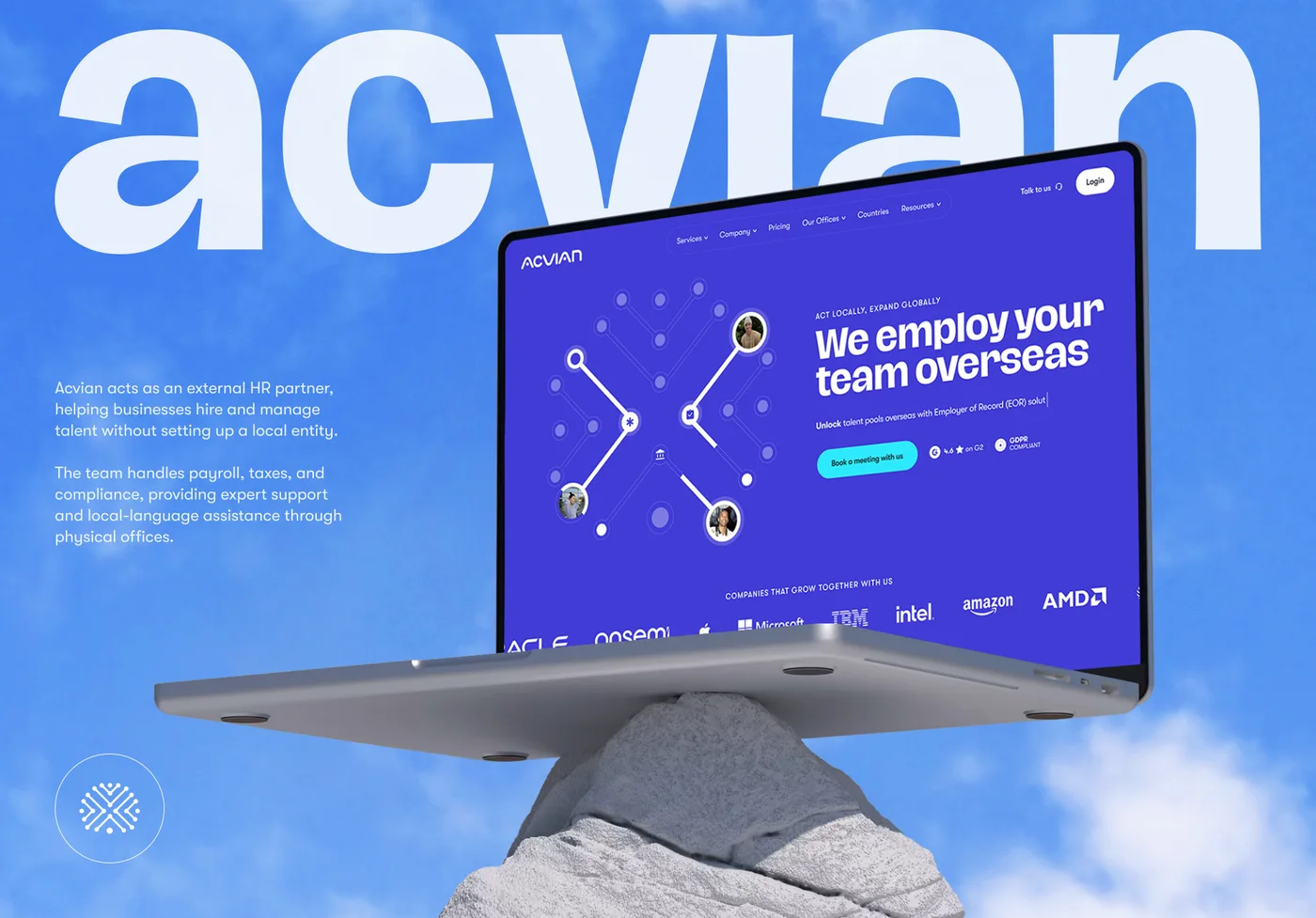 Acvian30+ pages in 60 days: a new Webflow site for a global HR partner
 CheckMyRate2 months from research to launch: a Webflow site for an Australian mortgage broker
 BloxFi80+ country pages from one template: how a fintech API went global
Want the same for your site? 30 minutes, free.
Book a free call ↗