
Contents
- What the thing actually does
- What actually disappears
- What is already built: three different things in one word
- What it costs
- Now about those 444 times
- The model never says it does not know
- Where it does not work
- Who is behind it, and what does not exist yet
- What to ask your team
- Where we stand
- What this means for your site
- Frequently asked questions
On 15 September a company called TypeSafe AI released Jev, a model that answers with a value instead of a paragraph, and put 193.6x faster and 444.6x cheaper on its homepage. We checked those numbers against the vendor's own pages and against measurements other people published in the first week. The saving is real and it is counted in times, not hundreds of times; the part nobody puts on a homepage is that the model never says it does not know.
On 15 September a company called TypeSafe AI released a model named Jev. Its homepage carries two numbers in large type: "193.6x Faster, 444.6x Cheaper". Within days the model was in the tools your developers use, so there is a good chance somebody on your team has already said the word Jev to you, followed by a sentence about how much money this will save.
This page is for the person who decides and does not write code. Below: what the thing does, what is already working with it and what was only shown on video, what it costs, where the headline number comes from and why it does not add up, and the risk that no vendor puts on a homepage. Everything here is checked either against the vendor's own pages or against measurements other people published and signed their names to. There is no code on this page.
What the thing actually does
Today a program sends a question to a model and gets back a paragraph of text. Then a second piece of code reads that paragraph and digs out the one word the program needed: a category, a yes, a number. That second piece of code is written by hand, it is maintained by hand, and when the model phrases its answer slightly differently one night, that is the piece that breaks.
Jev answers with the value itself. What comes back is the answer: option three out of eight; a score of four on a scale of five; a number between zero and one. For a choice and for a score, a figure for how sure the model is comes back beside the answer, and the program decides whether that is enough to act on. The vendor's documentation names the three kinds of question after describing them: pick from a list is called Choice, rate against a scale is called Score, a number between zero and one is called Noul.
Two properties matter for the money. All three kinds of question fit into one request, and the documentation says that adding questions barely changes the response time. And the model cannot write text at all. It is not a replacement for a chatbot, which the vendor's own people say plainly: "It's not really a chat interface, it's meant for consumption by machines".
What actually disappears
The clearest small example comes from a helpdesk that deleted a whole list from its own code. Its team used to keep a hand-written list of subject-line prefixes in several languages to catch automatic replies and spam. On the day Jev came out they replaced that list with three questions asked in one request. Sorting one message into those three answers takes 639 milliseconds, under a second, and the whole thing costs "about 36 cents a month".
That is the shape of the gain, and it is worth holding onto before any large number arrives. A piece of code that somebody on your team maintained is gone, and what replaced it is three sentences written in plain words.
What is already built: three different things in one word
A week after release there were something like a hundred projects on show. They are not the same kind of evidence, and the difference decides whether a number applies to you. We separate them into three groups and never mix them.
**Working in a live product, built by somebody other than the vendor.** There are two. A data warehouse company added a classification function that its paying customers can use: on a hundred thousand news headlines the function processed 2,484 rows a second at 89% accuracy for 50 cents, where the model it replaced took half an hour and $37.58 for the same work. And the helpdesk above, filtering real mail since day one.
**Measured on real data, but not switched on for customers.** This group is larger and more useful. A team that grades answers, working in early access on the day of release, reported $160 per million graded answers against $33,000 for a big general-purpose model, the kind that answers in chat, with the two agreeing 91.5% of the time. A security team ran 100 real agent calls and got 93% to 95% correct against 98% from the same kind of big model. A company that processes expense reports classified 2,000 of them in 21 seconds for about five cents and wrote, in the same post, "None of this is in production yet, it's just alpha work." A team doing record matching cut model cost by 99.56% and stayed within half a percentage point of the frontier model's accuracy.
**Shown on video, and the authors say so themselves.** A browser agent books a flight in 7.1 seconds, and its own read-me says this is "three repeats of one task on one browser profile, not a general reliability benchmark". A drone flies an obstacle course in a simulator, and its author writes that Jev "cannot be the perception layer, and it cannot run at control rate". A trading bot decides buy or sell every 300 milliseconds, three times a second against a real exchange order book, the live list of offers to buy and sell, with simulated fills and no money in it.
The loudest example of the week came from a post that has been seen 112,575 times. The founder of a company that sells automated accounting wrote: "The bookkeeping services industry is dead… I fed it 34 months of work a firm charged $20,000+ for. Jev did a better job in 20 seconds, for just $0.32". Thirty-four months of work that a bookkeeping firm billed more than twenty thousand dollars for, run in twenty seconds for thirty-two cents.
Two things belong next to that number. The author sells a product that promises on its own website to "replace QuickBooks plus manual bookkeepers", so the industry he says is dead is the one he competes with. And the two figures are different kinds of thing. A firm's fee covers judgement, liability, talking to the tax authority and a signature on a filing; the model sorted transactions into categories. The comparison that would tell you something is not against the firm's fee. It is against what that same sorting costs you today by some other means.
That split is worth one question to your team about any demo they show you: which of the three is it? A number from the third group tells you what the model can do on a good day. Only the first group tells you what it does on an ordinary working day.
What it costs
There is no pricing page. Both addresses where one would be return an error. The entire price of the product is four rows in a table inside the documentation: $42 per billion tokens of input, a token being the piece of a word the model counts in, and the answers are free. In a unit you can hold: sorting a hundred thousand news headlines cost fifty cents in the measurement above.
Two things on that page belong in any budget conversation. The limits on how much you may send are "adjusting dynamically" and "can change without notice". And the vendor writes, in its own launch post, "We can't prove it isn't subsidized". That is an honest sentence and it is also a warning: the price you plan around is a price the seller declines to guarantee.
Now about those 444 times
The homepage says 193.6 times faster and 444.6 times cheaper. Directly below it, the same page shows the demonstration those numbers are supposed to rest on: one request costing $0.000081 and finishing in 0.114 seconds, against $0.013880 and 8.566 seconds. Divide them, as we did. That is 75 times faster and 171 times cheaper. The page's own proof does not produce the number printed above it.
The launch post is more careful, and to the vendor's credit it names its own weak points. The headline figures, it says, come from four workflows and "we expect that these are on the higher end of real world gains". The correct answer used to score everyone was "the average of GPT-6 Astra and Fable 5.1", two competing models, which the post admits "biases answers towards OpenAI and Anthropic's models". And the workflows "were made by individuals on our model capabilities team, so some bias could exist".
The vendor's own comparison table is the most interesting page it publishes, because Jev does not win it. Jev scores 67.8% accuracy, which is roughly one answer in three wrong. Two other models score 74.1% and 73.1%. Jev is level with a third at 67.8%. What Jev does win on is price and time per case, by a distance.
In that table, find the competitor closest to Jev in price and speed with roughly the same accuracy, and divide the vendor's own published numbers. The result is about 32 times faster and about 8 times cheaper. That division is ours, on their figures.
Then there is a measurement made on a team's own live mail. A team ran Jev and its existing model through its own mail system and found Jev "Twelve times faster at the median", 605 milliseconds against 7,326, half a second against seven and a half. Then it kept going, which is what makes the post worth reading: "Divide latency by output tokens and the gap narrows to roughly 3x". And separately: "Per input token the two are 1.31x apart. The whole of the rest is that Jev does not charge for output at all."
The honest version of the headline is this. It is cheaper and it is faster, the gain runs to tens of times, a large part of the saving rests on the answers being free today, and another part of it comes from asking in small questions with ready answers.
The model never says it does not know
The vendor does not hide this. The homepage promises "Zero Hallucinations", meaning nothing invented. The launch post explains what that means: "Our number is not empirical. Schema matching is guaranteed, thus we can confidently add 0% into the plots." The guarantee is about the shape of the answer, nothing more. The company's own answers page puts it more bluntly still: the model "can't invent a category outside that list, but it can choose the wrong one".
What that looks like in a measurement: an independent evaluation put thirty messages that were outside the question's scope in front of the model, and it flagged none of them, answering at 0.99 confidence. A cake recipe came back classified as a technical issue at 0.94, random letters at 0.97. In separate work by another researcher, among the answers where the model was least sure, 16.6% were still dangerous ones.
The sharpest statement of the problem came from a reader arguing with the company's founder in public: "An approve for an unauthorized action still meets the schema guarantee… I still have to define the constraints and test which wrong actions get through the complete workflow on my own data. That's a substantial part of the work being pushed back onto the developer."
This is the honest trade. The code that dug an answer out of a paragraph is gone. In its place comes a decision that somebody on your team now owns: at what level of confidence do we act, and who checks the answers that come in below it.
Where it does not work
- Languages other than English. In one measurement, the same task scored 14.6% on the Chinese part of the data against 57.7% on the English. Nobody anywhere has published a single number about how it behaves on Ukrainian.
- Long documents with many categories. A developer trained a small model of his own on 250 labelled rows and beat Jev on topic classification by 12 percentage points, a gap too large to be chance.
- Anything that needs eyes. It does not see images. In the drone demonstration the picture was turned into text by other software first, and the author says so himself.
- A large part of the gain belongs to the way of asking. In the vendor's own table every model improves when the same task is split into small questions with ready answers. One small model goes from 18.1% to 53.6% that way: about one answer in five right before, more than half after. A good part of what is being sold as the advantage of this model comes from asking differently, and that works with any model.
Who is behind it, and what does not exist yet
TypeSafe AI was founded in 2024 and raised a $40 million seed round led by DCVC, which both the funding announcement and the investor state. Its own company profile gives a staff of between 11 and 50, and it is based in San Francisco. The waiting list closed on 20 September, so anyone can sign up now.
What does not exist is independent verification. The company says openly that it does not publish, with its releases, the standard comparison tables everyone else is measured by. There is no research paper. The model is absent from the usual independent leaderboards. Everything above that comes from outside the company was published in the last seven days, some of it by companies and some by single developers, and none of it has been repeated by anybody else.
One more thing worth knowing before you read anybody's review. A large platform company added Jev to its own product and published nine pages about it in four days. We read seven of those nine and not one contains a measurement of its own; in one the numbers are stated outright to be invented for the example. That is a sales channel writing about what it sells, which is allowed, and it is also the reason to ask of any enthusiastic page who benefits when you say yes.
What to ask your team
- Which of our tasks is a choice from a list? If the answer is none, the conversation ends here. This model does one thing: it picks from a list, it rates against a scale, and it says how sure it is. Everything the company sells rests on your having a task of that shape and running it often.
- How much does that task cost us a month right now? Without that figure nobody can estimate the saving. A team that pays forty dollars a month for classification will not notice a 90% cut; a team that pays four thousand will.
- At what confidence do we act, and who decided that? This is the work that arrives in exchange for the work that goes away. If nobody on the team can answer, the saving has been counted and the new job has not.
- What happens to a message our questions do not cover? The answer will come back looking confident. Ask what the team plans to do about that, and ask it before the launch rather than after the first incident.
- Which of the three groups is the demo you are showing me? Working in somebody's live product; measured on real data but switched off; recorded once for a video. The three carry different weight, and the difference is usually written in the author's own text.
AI products we designed for clients, among them Sona AI, an assistant with chat, images, video and code in one place, and a client's review on Clutch.
 Sona AIAI assistant with chat, images, video and code in one place. Product design and brand.
 AI Drone ChatBotAI chatbot for drone operators. Product design as part of the startup's dedicated team.
«The guys over-delivered and addressed our request changes promptly, resulting in a smooth engagement.»
 Artem KuzmychCOO · Clutch
Where we stand
Figmatica builds websites and the software around them, and our own site runs an assistant that makes exactly this kind of choice: which page to open for a visitor, out of eight. So we have a reason to want this to work and you should read the page knowing that. Our reading of the first week is that the saving is real, that it is smaller than the homepage says, and that it arrives together with a new job nobody has priced: deciding when an answer is sure enough to act on.
The numbers on this page come either from the vendor's own pages or from measurements other people published, and the link sits at the first mention of each. If one of them is wrong or has gone out of date, write to hello@figmatica.com and we will check it the same day.
What this means for your site
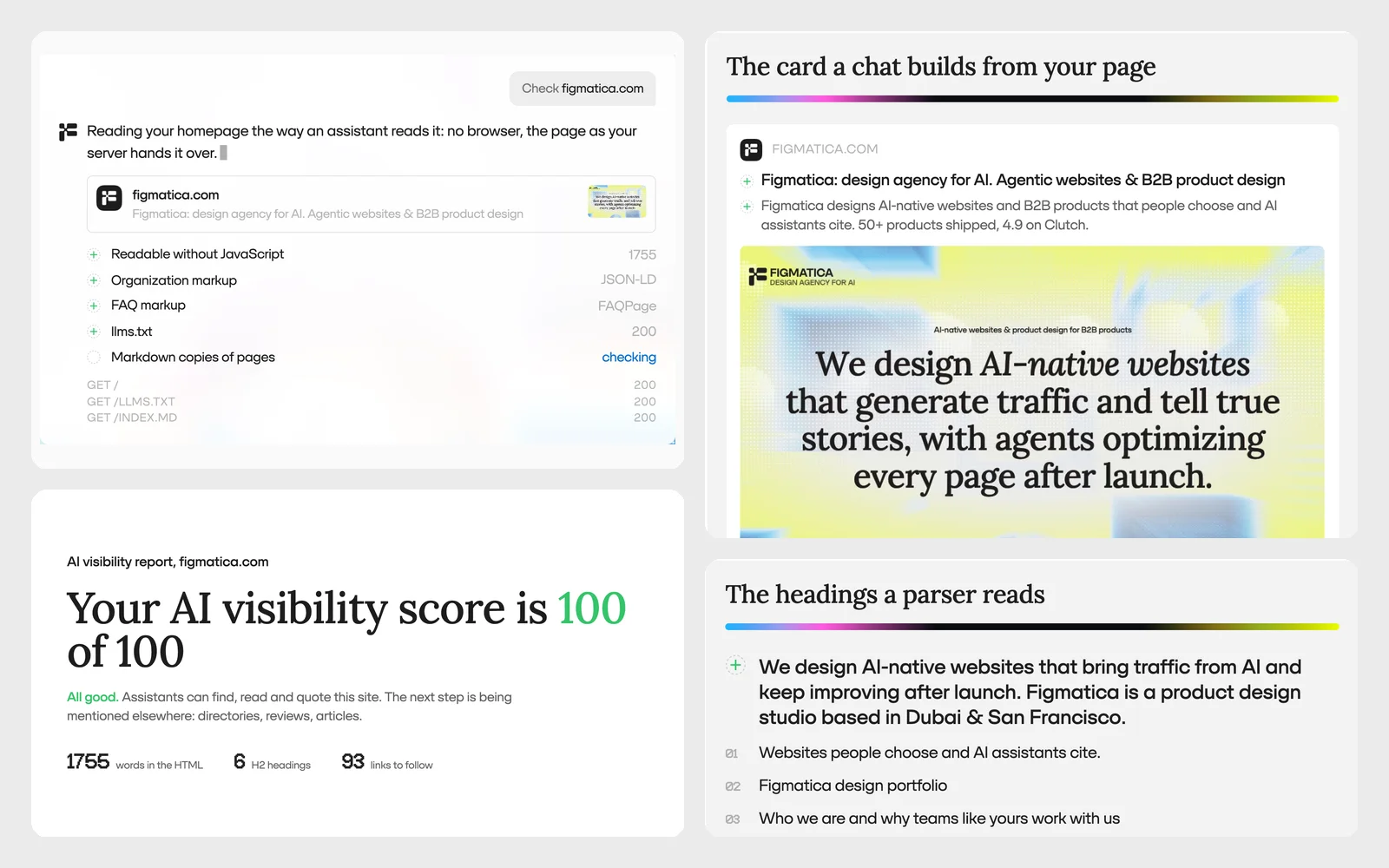
Models like this one choose from a list, and when someone asks an assistant for a studio, a shop or a service, your site is one of the options on that list. For the full picture, with your buyers' real prompts, your competitors and a list of fixes, there is our AI visibility audit.
Key takeawayCheck for free what ChatGPT, Claude and Perplexity can read on your site: six checks on your homepage.
Websites and products we shipped
 Acvian30+ pages in 60 days: a new Webflow site for a global HR partner
 BloxFi80+ country pages from one template: how a fintech API went global
 CheckMyRate2 months from research to launch: a Webflow site for an Australian mortgage broker
Want the same for your site? 30 minutes, free.
Book a free call ↗